People now ask AI long questions and get simple, precise answers without clicking a single blue link. So, as a business, you may now see that generative AI search engines are the entry point to your company in the market.
Previously, we explored the differences between GEO, SEO, and AEO and discussed how GEO and traditional SEO are changing the way businesses approach online visibility. We also explained how these strategies work together to help brands appear in traditional search results, direct answers, and AI-generated recommendations.
But understanding these strategies is only the first step. The next question is: How can you actually optimize your website for generative AI search engines?
Need a hidden playbook to improve AI visibility of your brand? Well, there is one. But you need to add a few steps to your AI search optimization strategy.
Let’s talk about them.
How Does Generative AI Search Engine Optimization Work?
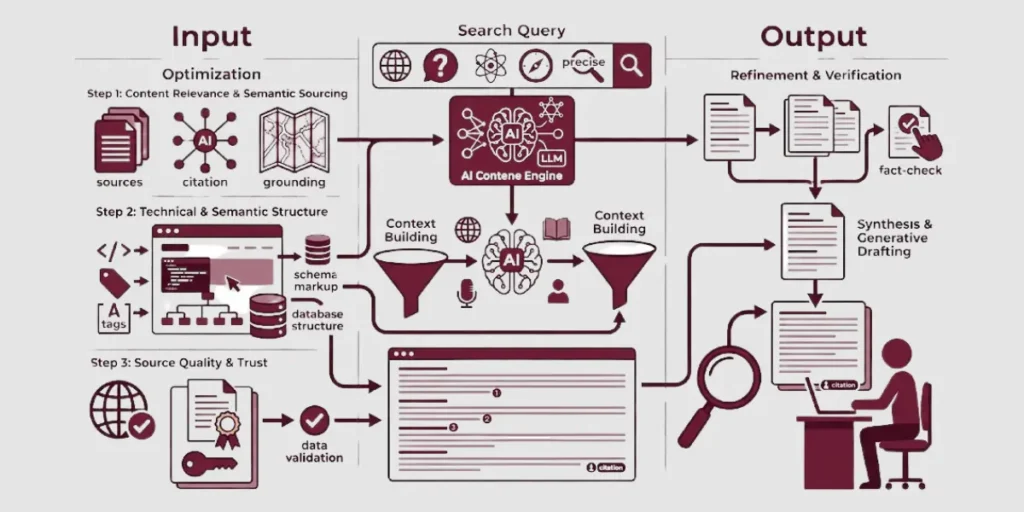
First, you must understand how Generative Engine Optimization (GEO) works. Google says there are 2 mechanisms:
- Retrieval-Augmented Generation (RAG): The AI system extracts the relevant, latest data from the index. Then it writes the response using those sources.
- Query Fan-out: The model starts multiple related searches all together. It’s like it explores the main topic with subtopics.
That’s why one strong page can cover many aspects of a topic, and why AI SEO in 2026 offers more in-depth benefits than keyword variants.
How to Optimize a Website for Generative AI Search Engines: 8 Steps
If you are still trying to figure it out, here is your guide to the basics:
Step 1: Make Your Pages Eligible
Stick to the basics first. Your page needs to be indexable and eligible for Google Search with snippets. So, what should you avoid to ensure your site appears in generative AI features in Search Console?
- Avoid accidental noindex tags and login walls.
- If your content is rendered client-side, follow the JavaScript SEO best practices.
- Fix duplicate URLs and make sure pages are fast and mobile-friendly.
Step 2: Publish Non-Commodity Content
In the long run, the guide will likely matter more for its unique, valuable content than anything else. Commodity content is generic, such as “7 Tips for First-Time Home Buyers.” A first-hand story will resonate more, like why you waived an inspection and what the sewer line revealed.
Here is what you need to publish:
- Original Data, Case Studies, Test Results, Real Pricing
- Don’t say what others said; say what you personally did.
- Don’t create near-duplicate pages for each variation of a query. Google considers doing this to game results as scaled content abuse.
Step 3: Write for Humans First
Well-structured content with clear headings and logical sections is also easier for readers to read, with the direct answer near the top. Google’s systems can pick up on nuance on a page, so you don’t have to write in an “AI style.”
Step 4: Add Strong Images and Video
AI features can take images and video, meaning more ways to show up besides text links. Follow the Google image and video SEO documentation.
Step 5: Keep Business and Product Data Accurate
Generative answers can include local business info and product listings. Maintain Merchant Center feeds and Google Business Profile accuracy and freshness.
Step 6: Skip the Myths
For Google Search, you can overlook these items:
- llms.txt and other specialized AI files (they’re harmless and won’t be flagged by Google)
- Dividing content into tiny “chunks”.
- Rewriting pages just for AI purposes.
- Chasing after inauthentic mentions.
- Special schema for AI (although structured data is still valuable for rich results).
Remember these are Google’s rules, and other AI platforms may work differently. Just check with their models and functions.
Step 7: Prepare for AI Agents
AI agents can help you compare products or make reservations. Browser agents can examine page visuals, the DOM, and the accessibility tree. Make things easier for them by using semantic HTML, clear labels, and accessible forms.
Also, keep an eye on new standards like the Universal Commerce Protocol (UCP) – they could be significant in the future.
Step 8: Measure What Matters
Don’t forget to use the Generative AI performance report in Search Console. Google has cautioned that no third-party tool can access its internal ranking systems, so treat those “AI visibility” scores as helpful workflow aids instead of concrete truths.
How Can Websites Rank in AI-Generated Search Results?
Make sure your content is easy to find, truly helpful, and stands out from the crowd. These AI search optimization strategies work because they prioritize reader needs, which is exactly what search engines aim to highlight.
Google also mentions that you don’t have to follow every tip in their guide to succeed.
Do You Need Outside Help?
Some businesses manage their SEO in-house, while others prefer to work with experienced professionals. If you decide to hire an SEO agency in the UAE, look for a team that understands your business goals and has a clear strategy.
Avoid companies that promise guaranteed AI citations or claim to have secret SEO (Search Engine Optimization) techniques. Instead, ask for case studies, review their previous results, and understand how they approach SEO. The best SEO company in the UAE will focus on sustainable growth, follow Google’s guidelines, and set realistic expectations rather than making promises they cannot guarantee.
Final Thoughts
Generative AI search engine optimization isn’t a completely new area; it’s really just classic SEO done right, with a stronger focus on originality and accessibility.
Create pages that will delight your visitors, and make sure your technical groundwork is clean. The citations will typically come along with that.
As generative AI search engines continue to evolve, businesses need to make their content easy to find, understand, and trust. If you’re looking for website optimization for AI search and want to improve your visibility across AI platforms, Digital Hub Sol offers reliable SEO services in the UAE.
Our SEO experts focus on practical strategies that help your business build online visibility, attract the right audience, and achieve long-term growth.
Frequently Asked Questions
Results vary depending on your website’s content, authority, and technical health. Consistent improvements can help build visibility over time.
Yes, traditional SEO remains important for website discovery and visibility. Strong technical SEO and helpful content also support your chances of appearing in AI-generated answers.
Yes, small businesses can gain visibility by publishing useful content and sharing real expertise. Accurate business information and customer reviews can also build trust.
You can test relevant customer questions across different AI platforms. Regularly monitor brand mentions, citations, referral traffic, and changes in website visibility.