
Customers no longer type keywords into Google and scan information or solutions through blue links. They now ask ChatGPT, Perplexity, Claude, or Google AI mode for any recommendations. These customers are almost ready to act; they just need suggestions to compare and decide.
So how can you get your business to show up in these AI-powered search engines? This is where you need Generative Engine Optimization.
This Generative Engine Optimization guide explains the concept and what it means for businesses like yours.

What is Generative Engine Optimization?
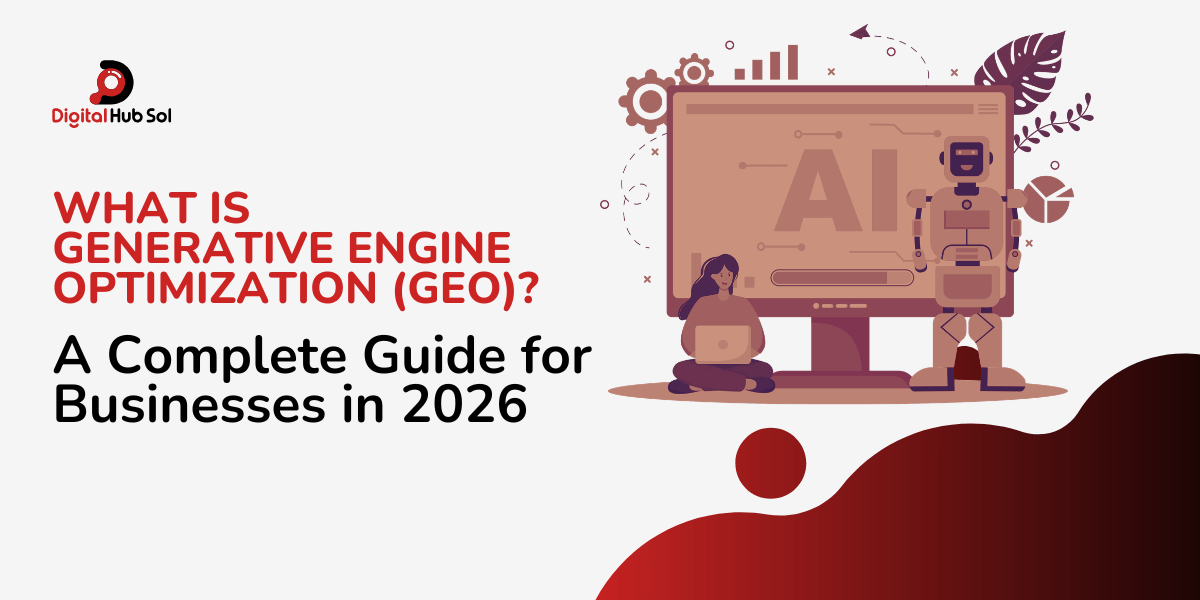
GEO is the practice of increasing the likelihood that a brand, its expertise, and its content will be retrieved, cited, accurately represented, or recommended in AI-generated responses.
This includes Google AI Overviews/AI Mode, ChatGPT Search, Perplexity, Gemini, and Claude. A KDD 2024 research paper has formalized the term, defining it as increasing visibility within generative responses, not only in traditional rankings.
The industry still lacks a settled label. A 2025 survey associated with Aleyda Solis found only 18% of respondents use “GEO”. These disciplines overlap:
- SEO: General visibility in usual search results.
- AEO: Direct answer for a concise response.
- GEO: Answer or information appearing on AI.
- AI Search Optimization: The main umbrella holding all 3.
Why is Generative Engine Optimization Important in 2026?
Businesses are looking for ways to show up in the search of their customers’ searches. Their customers, however, are busy asking AI for solutions to their problems.
So companies are left wondering how to appear in AI. GEO has the answer to it. First, businesses need to be discovered. For example, if a buyer asks ChatGPT to recommend the best SEO companies in the UAE, does your company show up on the list?
If not, then you need to understand that AI is not just going to pick self-claims from your website. It is going to rely on recommendations from your customers, your media coverage, or social media reviews.
Your pages also need entity signals, along with independent proof AI can rely on for answers. Now, this is what GEO play is. How it works and what steps you need.
Keep reading.
How does Generative Engine Optimization Work?
AI answers usually come from a process that searches multiple relevant pages, gathers useful data, and then puts together a direct answer while offering sources.
Google explains that features like AI Overviews and AI Mode might use a method called “query fan-out”. This idea involves running multiple related searches simultaneously across different subtopics and data sources.
Therefore, your content needs to address subtopics while answering the question. Be realistic about what counts as “special” here.
According to Google’s documentation, “There are no additional requirements to appear in AI Overviews or AI Mode.”
This means GEO doesn’t mean SEO is no longer necessary; it builds on indexable pages, valuable content, and precise structured data. It also highlights the importance of citation-worthiness, clear entities, and third-party validation.
Generative Engine Optimization Guide: The Step-by-Step Process
So, how can businesses optimize for AI search engines?
You just need a few steps to follow:
Step 1: Baseline Your Visibility
- List 20- 30 real prompts from real users.
- Now, run them through different AIs like Gemini/Google AI Mode/Perplexity/ChatGTP.
- Have a close look at your mentions, citations, recommendations, accurate descriptions, and links.
Step 2: Fix Technical Access
- Make important pages crawlable and indexable.
- Allow AI-SearchBot to be eligible for ChatGPT search results. It’s not the same as the GPTBot that was used to train the model.
- Keep the structured data accurate and consistent with the visible information.
- Remember, access is a condition for eligibility, not a guarantee of citation.
Step 3: Make Your Entity Unmistakable
- Brand name, people, products, places, qualifications, policies, and category claims must be consistent.
- Make sure your website matches the trusted third-party profiles.
Step 4: Publish Original Information Gain
- Use firsthand information, real-world examples, expert analysis, product testing, price context, and established procedures.
- If your page is just rehashing the same information as the top 10 results, an AI has no reason to cite you.
Step 5: Structure for Retrieval
- Use clear headings and direct definitions at the top.
- Write self-contained chunks that make sense even when taken out of context.
- Provide comparison tables, brief evidence-based statements, FAQs, and extensive image/video assets.
Step 6: Earn Third-party Corroboration
- Look for reputable reviews, expert opinions, mentions in publications, industry listings, and community forums.
- This is beyond on-page editing; it’s digital public relations & reputation management.
Step 7: Measure, then Iterate
- Run your prompt set again every month.
- Don’t just look at ranks. Look at mentions, citation accuracy, and traffic from AI.
- Correct wrong descriptions at the source.
Generative Engine Optimization Strategies that Hold Up
Now, if you are planning to work with and even hire the best seo company in the UAE, you must understand some of the strategies that will hold up.
- Focus on evidence rather than tricks. Yes, citations can increase visibility. But it doesn’t guarantee that outbound links will actually lead to citations in real-world AI applications.
- Claim a specific niche. Do not ramble about everything. AI recognizes brands that master a specific niche.
- Keep key pages up to date. Always update your pages, be it content, pricing, stats, or any other information.
- Steer clear of shortcuts. Good results take time, so don’t depend on mass-produced, nearly identical “AI content”; it goes against the rules of being helpful and putting people first.
When to Use Generative Engine Optimization Services
GEO encompasses everything from content and technical SEO to public relations and analytics, prompting many companies to seek external help.
If you’re in the market for SEO services in Dubai or throughout the UAE, look for a partner that views AI visibility as an enhancement to solid search engine optimization services, not a replacement.
Before you hire an SEO company or an SEO provider in the UAE, be sure to ask:
- Are they auditing AI prompts, or is it just about keyword rankings?
- Can their SEO experts provide original content and PR work instead of just reports?
- Do they steer clear of guaranteed citation promises? After all, no one can control AI outputs.
- Is their reporting transparent and linked to actual business outcomes?
Anyone who claims to be the top SEO company in the UAE or the best SEO agency should back it up with documented case studies, not just catchy slogans.
Final Thoughts
GEO focuses on brand visibility by offering a strong foundation for AI users. This means you need user-friendly pages, field expertise, and reliable third-party references.
Start with a clear prompt, understand user intent, and polish your content and strategies accordingly. When you do it right, Generative Engine Optimization amplifies the effectiveness of everything you’re already doing in SEO.
Now, for seo services in the UAE that also cover GEO, Digital Hub Sol has a plan for you. Let’s talk.
Frequently Asked Questions
Generative Engine Optimization (GEO) improves brand visibility in AI-generated answers. It helps businesses get discovered, mentioned, cited, and recommended across AI-powered search platforms.
GEO improves content quality, brand authority, and online credibility. These factors increase the chances of businesses appearing in relevant AI-generated recommendations and answers.
SEO focuses on traditional search rankings, while AEO targets direct answers. GEO optimizes brand visibility and content presence across generative AI platforms.
Businesses can improve AI visibility through authoritative content, technical SEO, structured data, and trusted third-party mentions. Regular monitoring also helps refine GEO strategies.